


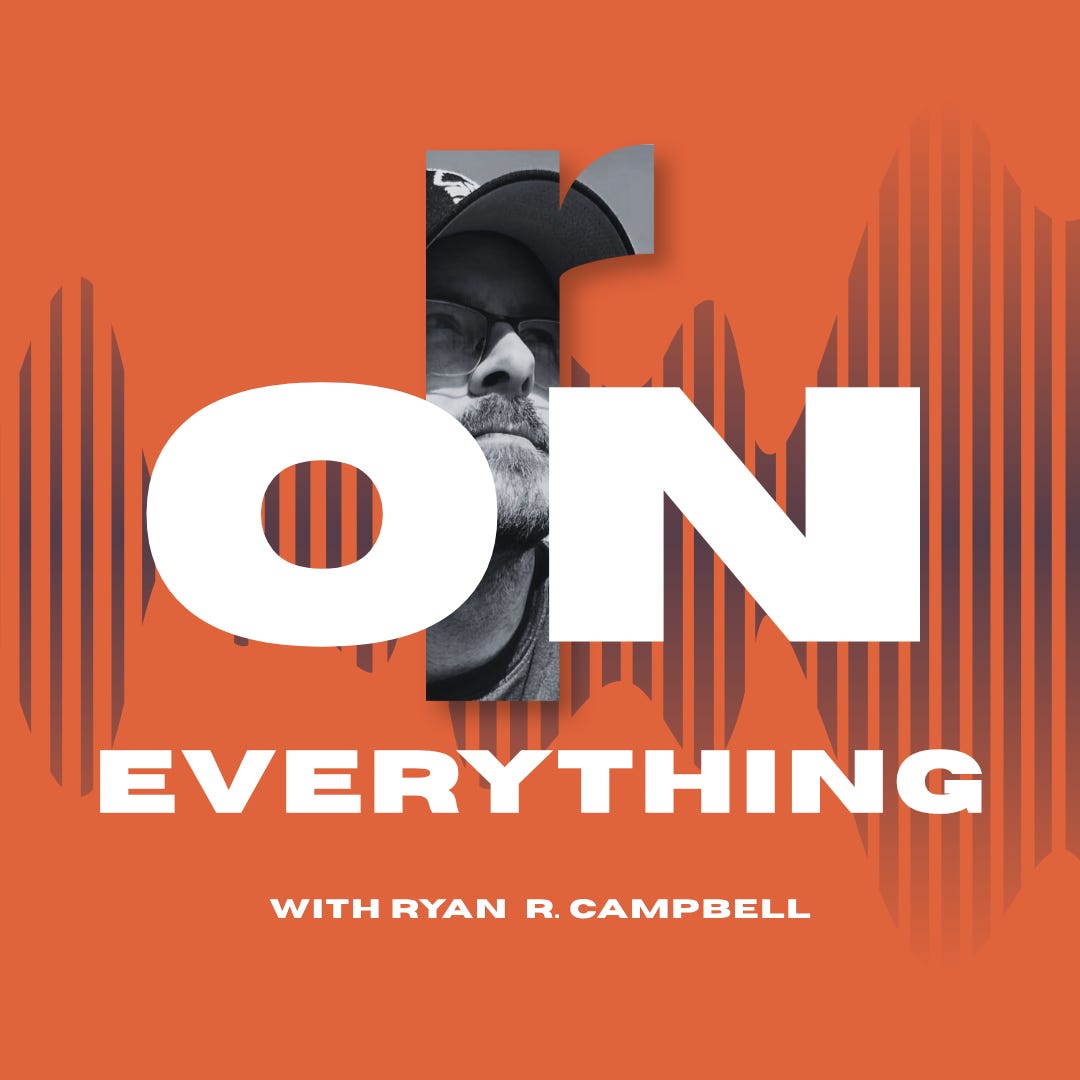
Some ideas ask to be written. Others demand to be spoken.
Since its inception, R: On Everything has been exclusively a written project, a place for me to think through questions about technology, work, creativity, leadership, culture, and the connective tissue that binds them to one another. The essays we share here give me room to research, revise, reconsider, and develop a deeper understanding of the topics that return to me time and time again.
Those who have been following me for years know, however, that writing is only one way to explore an idea.
That’s why I’m launching the R: On Everything podcast, a new way for us to examine the forces reshaping our lives.
Why a podcast?
I’ve spent a good portion of my creative life behind a microphone. Before R: On Everything, I hosted and produced podcasts through the Writescast Network, where I spoke with authors, editors, publishers, and other creative professionals about the craft of creative writing and what it took to build a sustainable and sustaining creative life.
In 2020, though, I stepped away from podcasting altogether. This was the right decision at the time: the conversations I wanted to have were expanding beyond publishing, and, as I juggled other significant life challenges, I needed the space to figure out what connected this new, more diverse set of interests.
Years later, R: On Everything became that space.
More recently, however, I’ve found myself hearing some of these essays as I write them. Certain arguments have seemed to ask for cadence, emphasis, and the occasional pause. Some ideas became clearer when I imagined explaining them to another person rather than arranging them on a page. Others opened doors to stories, asides, and connections that didn’t belong in the written version but felt entirely natural when spoken aloud.
This podcast gives those ideas somewhere to go.
It also creates a more human kind of connection. Writing allows me to choose each word carefully; audio lets you hear the uncertainty, humor, frustration, curiosity, and conviction behind those words. Neither form is inherently better. They simply reveal different parts of the thought—and, inevitably, different parts of the person doing the thinking.
This isn’t an audio version of the newsletter
The podcast and the essay feed will overlap, but neither will be a perfect mirror of the other.
Some episodes will begin with essays published here, particularly when I think an argument would benefit from being adapted, expanded, or reconsidered in another medium. Even then, I don’t plan to simply sit down and read the post into a microphone. The audio version may follow a different structure, incorporate new material, or arrive somewhere the original essay did not.
Other episodes will be created specifically for the podcast, and others still will give us room to revisit older ideas, connect themes across multiple essays, and respond more quickly when something happening in the world demands attention.
Likewise, some essays will remain essays. I don’t intend to force every idea into every format merely because both are available. Rather than produce the same material twice, we’ll let each idea find the form—or forms—that serve it best.
If you read and listen, the two feeds should complement one another. If you prefer only one medium, each should still stand on its own.
What you can listen to today
The short podcast teaser is live now, along with the first full episodes, “AI Isn’t Inevitable. We’re Choosing It.,” “Stop Following Your Passion. Build It Instead.,” and “Why People Resist Change—and What Leaders Keep Getting Wrong.”
The first of these examines the way technological change is often presented to us as something automatic and unstoppable: a future that simply arrives, leaving ordinary people with no meaningful role except to adapt.
It should likely go without saying that I don’t believe that story. Technology may create possibilities, but people and institutions still decide which possibilities receive funding, legitimacy, and power.
In other words, the future doesn’t simply arrive. People build it.
That argument captures much of what I want this podcast to do. R: On Everything will take seriously the enormous changes unfolding around us without treating their consequences as foregone conclusions. It will resist both reflexive techno-optimism and reflexive despair. Most of all, it will remain interested in the choices hiding behind whatever we are told is inevitable.
The other two episodes that I’m releasing today establish the range of subjects and approaches you can expect from the show, and after that, new episodes will be released every other week.
That biweekly rhythm is intentional. I want enough structure to make the podcast dependable without manufacturing episodes simply to satisfy an unforgiving content calendar (I learned a lot from my time running the Writescast Network). These ideas deserve time to develop, and you deserve something more considered than another voice filling space.
One project, more ways to explore it
Although the format is new, the central curiosity behind R: On Everything remains the same.
What happens to people when systems change around them? Who benefits from the stories we tell about progress? How do we preserve agency, dignity, creativity, and meaning in institutions increasingly shaped by automation and scale? What can technology help us become—and what might it quietly train us to surrender?
Those questions can’t be contained within a single category. They lead from artificial intelligence to management, from publishing to surveillance, from mental health to craftsmanship, and from the future of work to the way each of us decides what constitutes a worthwhile life.
That is the territory of R: On Everything—not literally everything, but everything connected to the questions that matter.
The essays will continue; the podcast now joins them, not as a replacement or a replica, but as another way of thinking in public.
I hope you’ll listen.
Onward, upward, and keep curious,
Ryan
Not on Apple Podcasts? Tune in on one of the other platforms below.